Component supply is part of robot design. When your robot becomes inoperable because a single resistor or motor driver has vanished from every distributor, the dream of self-maintainable home robots can collapse on the workbench. At Shadowless Labs we treat component supply as a first-class design constraint and place it at the forefront of our project planning. Every schematic we release is chosen so that anyone, anywhere, can source, repair, or even substitute the parts without waiting months or paying counterfeit premiums.
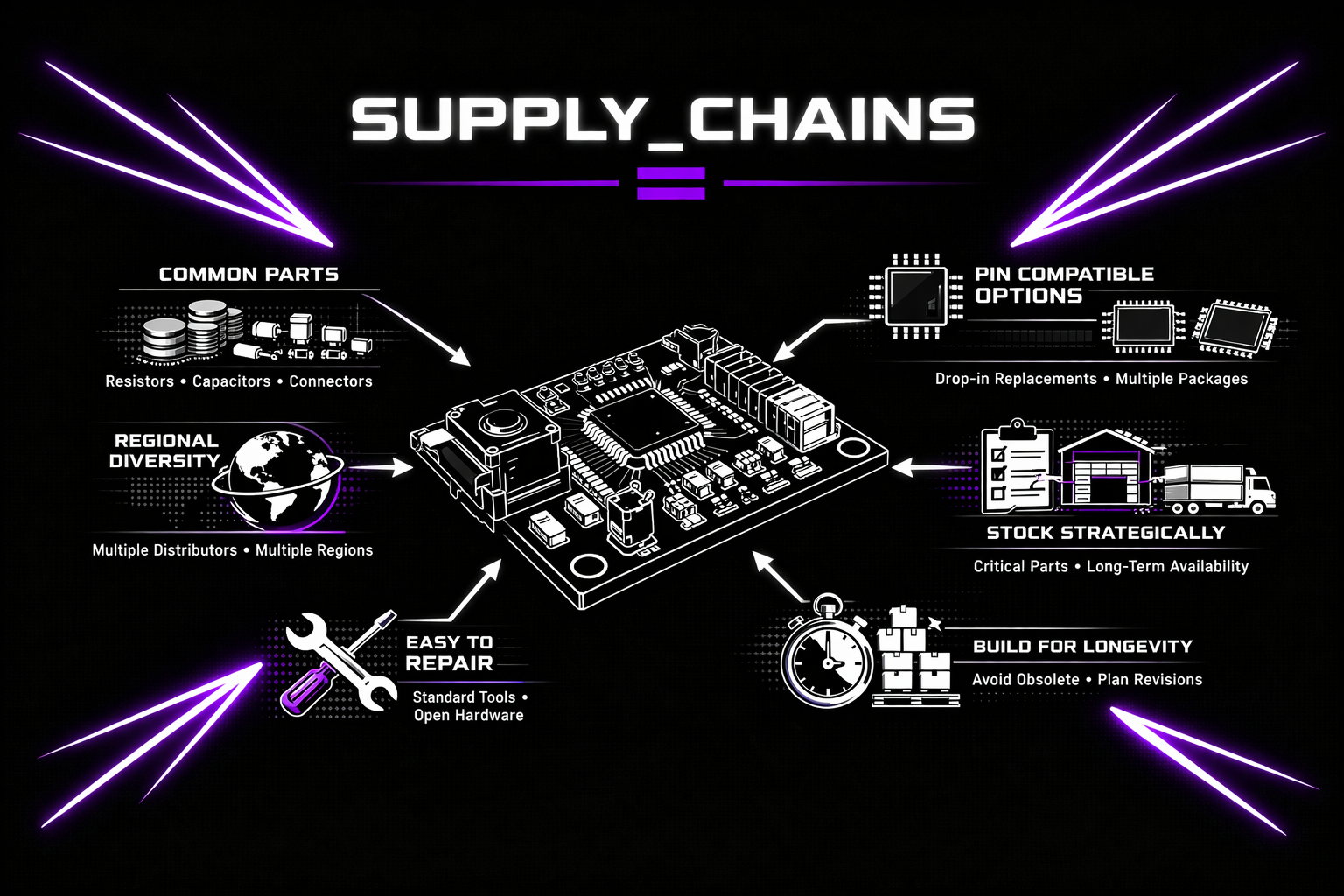
Obsolescence is normal. Parts disappear. Distributors run out. Prices swing. These have always been true within hardware, and even more so in today's world where supply chain disruption has become normalized. We start every project by asking one question first: “If this part vanishes tomorrow, can we still build and repair the machine?”
For many of the more common components, you will have no issue finding replacements. However, when it comes to microcontrollers or other more complex components, drop-in replacements may necessitate PCB design changes or require that you write new code to make the hardware function as expected. For such components, it is important to spend time at project inception to carefully consider supply availability of components for the duration of the expected project lifecycle. Subsequent sections of this article will expand on these aspects more deeply.
1) Design for Availability
A part is not truly viable just because it performs well on paper. It must also remain obtainable by builders months or years after the first prototype is assembled. We prefer components that are widely distributed, stocked by multiple vendors, and supported by a healthy manufacturing footprint rather than parts that look optimal but exist in a fragile supply position.
This often means choosing the slightly less glamorous option. A regulator with broader availability may be better than a more elegant alternative that appears only at one distributor. A motor driver with extensive field use and stable stock may be more valuable than a newer chip that promises marginal gains but disappears without warning. In open hardware, longevity matters more than novelty.
Designing for availability also changes how you think about success. The goal is not merely to get one board working on your bench. The goal is to create a machine that other people can realistically reproduce, maintain, and repair without entering a scavenger hunt across the global electronics market.
2) Critical Parts vs. Flexible Parts
Not every component in a design carries the same supply risk. Some parts are easy to replace with near equivalents. Others define the shape of the board, the firmware architecture, or the electrical behavior of the entire system. We think it is useful to divide a design into two categories: critical parts and flexible parts.
Flexible parts include many resistors, capacitors, connectors, and other support components where substitution is relatively straightforward. Critical parts include microcontrollers, camera sensors, motor drivers, power management ICs, wireless modules, and anything else that would force a board redesign or major software change if it vanished. These are the components that deserve the most scrutiny at the beginning of a project.
When you identify critical parts early, you can make better architectural decisions. You can ask whether a different footprint would increase future options, whether an established module is safer than a niche IC, or whether a slightly more common part would preserve the design longer. This discipline turns supply awareness into a concrete engineering practice rather than a vague concern.
3) Design for Substitution
No matter how carefully you plan, some parts will eventually become difficult to source. The question is whether your design can absorb that change gracefully. A resilient PCB is not one that depends on perfect continuity from the market. It is one that leaves room for adaptation.
Designing for substitution can take many forms. It may mean selecting components with pin-compatible alternatives, leaving enough layout flexibility for a nearby package variant, choosing voltage rails that support more than one possible peripheral, or avoiding overly specialized dependencies where a simpler architecture would do. These choices may seem small in the moment, but they determine whether a future revision is manageable or painful.
We do not view substitution as compromise. We view it as part of engineering reality. Hardware designed for the real world should be able to survive imperfect availability, shifting distributors, and unexpected discontinuations. A board that cannot evolve when the market changes is not robust no matter how clean the schematic appears.
4) Open Hardware Must Be Repairable
Open hardware is not just about releasing schematics or posting source files online. It is about ensuring that another person can actually build, maintain, and revive the machine without privileged access to the original creator's supply chain. A design that depends on rare or vanishing components may be visible, but it is not meaningfully open.
Repairability begins with sourcing decisions. If a robot fails because one irreplaceable chip is unavailable anywhere except gray-market listings of uncertain origin, the openness of the project becomes largely theoretical. For hardware to remain alive in the hands of the community, the path to replacement must be realistic.
This is especially important for small, human-scale robots intended to live in homes, workshops, and classrooms. These machines should not become disposable because one part goes missing from the market. We believe open robotics should be durable in practice, not merely open in documentation. That means designing around parts people can actually find, understand, and substitute when the need arises.