Some 3D-printed robot wheels look almost organic. Instead of rigid spokes running directly from the hub to the tire, they use long curved structures that branch, bend, and twist around the center in a maze-like pattern. The geometry resembles the patterns produced by reaction-diffusion systems, where simple local interactions can generate complex organic-looking forms. We refer to this particular design as a reaction-diffusion wheel.
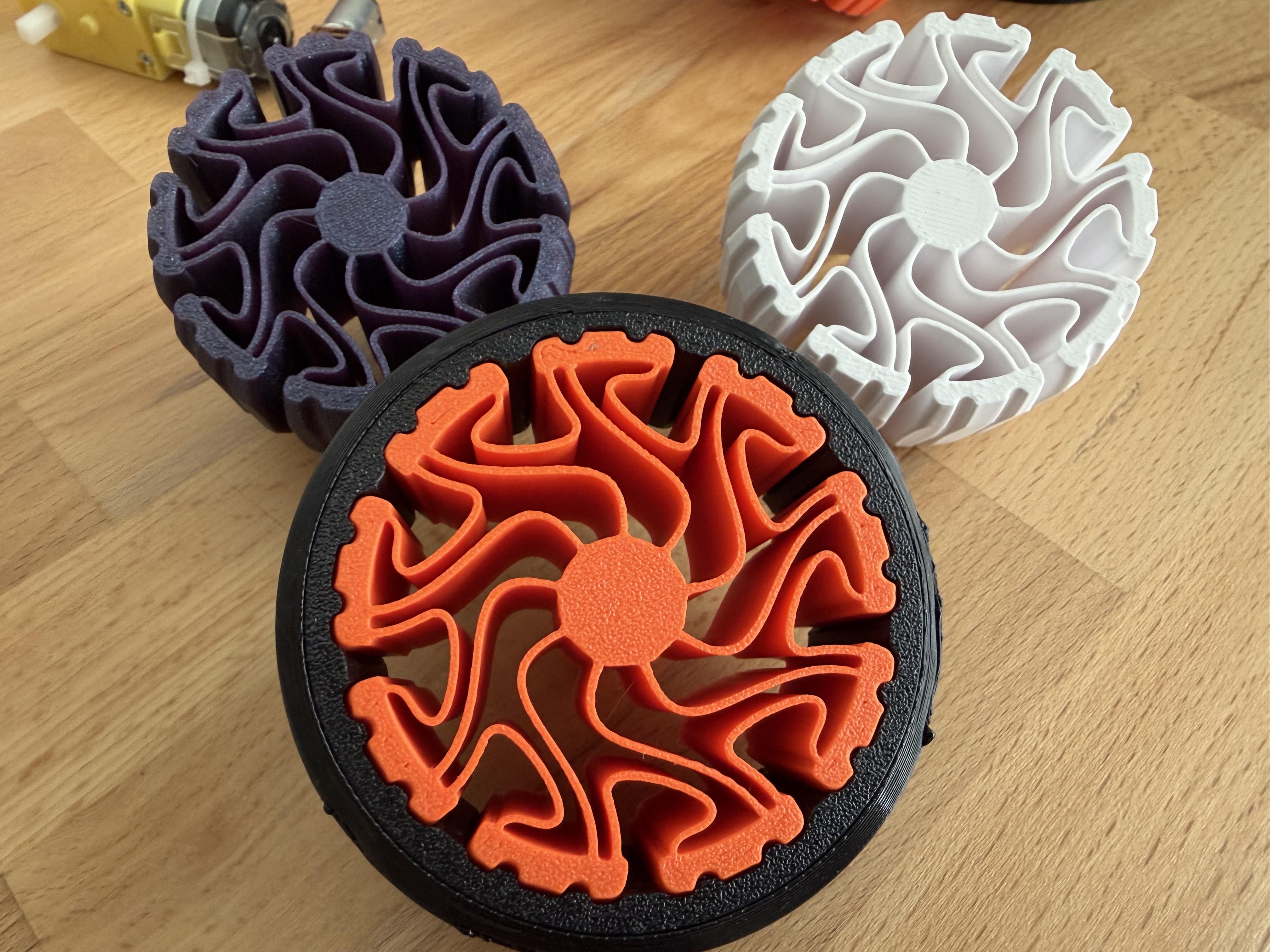
The name describes the visual character of the internal structure, but mechanically the wheel belongs to a broader family of compliant wheels and flexible airless wheels. The unusual pattern is not there only for appearance. By replacing short rigid spokes with longer curved load paths, the structure can flex under force and allow the wheel itself to absorb some of the movement that would otherwise be transferred directly into the robot.
This is an especially interesting design approach for small robots because it demonstrates a broader engineering principle: mechanical behavior does not have to come only from motors, bearings, springs, and separate moving parts. Sometimes the geometry of a printed component can perform part of that work.
1) The Wheel Becomes the Suspension
A conventional small robot wheel is usually fairly rigid. When it encounters a floor transition, cable, rock, tile edge, or other obstacle, the wheel must climb over it and much of that movement is transferred directly into the chassis.
One solution is conventional suspension. The wheel can be mounted to an arm, spring, pivot, or shock absorber that allows it to move independently from the robot body. This works well, but it also adds mechanical parts, mounting hardware, weight, assembly time, and additional points of failure.
A compliant wheel approaches the same problem from another direction. Instead of allowing the entire wheel assembly to move, the wheel itself is allowed to deform.
When the outside of the reaction-diffusion wheel encounters an obstacle, its curved internal structures can bend and redistribute the load. This lets the outer circumference move slightly relative to the central hub. Once the load is removed, the structure attempts to return to its original shape.
The amount of movement may only be a few millimeters, but on a lightweight robot that can be enough to absorb small impacts, reduce bouncing, and help maintain contact with uneven terrain.
2) Why the Reaction-Diffusion Geometry?
Reaction-diffusion patterns appear throughout nature as branching, striped, spotted, cellular, and labyrinth-like forms. Similar patterns can also be generated computationally from surprisingly simple mathematical rules. In this wheel, that organic visual language produces a network of long curved paths between the hub and outer rim.
From a mechanical perspective, those curved paths are what matter. Imagine replacing them with short, thick spokes running directly from the hub toward the outside of the wheel. A force pushing toward the center would mostly try to compress those spokes along their length, producing a relatively stiff structure.
A long curved spoke behaves differently. As the wheel is loaded, the structure can bend rather than simply compress. Bending a thin curved structure can require significantly less force than compressing a short straight structure.
The result is effectively a series of springs designed directly into the geometry of the wheel. The same pattern that gives the reaction-diffusion wheel its distinctive appearance also creates long, deformable load paths through the structure.
This means that the behavior of the wheel can be tuned. Changing the thickness, curvature, length, number, or arrangement of the internal paths changes how easily the wheel deforms and how quickly it returns to its original shape. The pattern is therefore not just visual styling. Geometry becomes a mechanical design variable.
3) Material + Geometry
These designs become especially useful when the compliant structure is printed in a flexible material such as TPU. A more rigid wheel structure can also be paired with a flexible TPU tire when additional grip and impact absorption are desired.
But flexible material alone does not produce the same behavior as a compliant structure. A solid block of TPU can still be surprisingly stiff. The important part is the interaction between material and geometry.
Thin curved structures concentrate deformation into predictable areas. A designer can therefore create a component that behaves much softer than a solid piece made from exactly the same material.
This is one of the most powerful aspects of additive manufacturing. Instead of simply asking what material has the mechanical properties we need, we can also ask what geometry will create those properties.
The reaction-diffusion wheel is a useful example of that idea. Its behavior emerges not from a complicated assembly of moving parts, but from the relationship between material, thickness, curvature, and the paths that forces take through the printed structure.
4) Why Use Them on a Robot?
For small mobile robots, compliant wheels can offer several useful properties without requiring additional electronics, sensors, or software.
- Passive absorption of small bumps and surface transitions.
- Improved contact with uneven terrain.
- No pneumatic tire that needs to remain inflated.
- Fewer mechanical components than a dedicated suspension system.
- Easy customization through changes to the printable geometry.
The last point is particularly valuable for robotics experimentation. Because the wheel is digitally fabricated, a builder can modify the spoke thickness, wheel diameter, tread, material, or even the reaction-diffusion pattern itself and immediately test how those changes affect the robot.
You could design a softer wheel for a lightweight rover, a stiffer version for a heavier machine, or produce several variations and experimentally determine which gives the best balance between efficiency and terrain compliance.
5) The Tradeoffs
Compliant wheels are not automatically better than conventional robot wheels. Their ability to deform is also the source of several disadvantages.
If the wheel is too soft, some motor torque can initially go into deforming the wheel instead of moving the robot. This can make acceleration and precise positioning feel less immediate.
Flexible wheels may also produce greater rolling resistance than rigid wheels. They can deform under lateral forces while turning, and repeated bending introduces the possibility of material fatigue over time.
The final behavior also depends heavily on printing parameters. TPU hardness, wall thickness, layer orientation, temperature, wheel width, and the geometry of the internal reaction-diffusion structure can all change how the finished part behaves.
For a robot designed exclusively for a smooth indoor floor or desktop, a conventional rubber wheel may therefore remain the simpler and more efficient choice. For a small rover expected to encounter imperfect terrain without the complexity of dedicated suspension, compliant wheels become much more interesting.
6) Experiment With One
One of the easiest ways to understand compliant mechanisms is simply to print one and handle it. Hold the hub and squeeze the outside of the wheel. You can immediately see how the curved reaction-diffusion structure distributes the load and allows the outside circumference to move relative to the center.
Then mount it to a robot and compare it with a conventional wheel of roughly the same diameter. Try both across cables, small floor transitions, uneven surfaces, or other obstacles. Observe how much the wheel deforms and whether the additional compliance actually improves the robot's behavior.
Once you understand the basic mechanism, modify it. Change the wall thickness. Alter the internal pattern. Print it in a harder or softer material. Add a different tire. Mechanical experimentation is one of the best ways to develop intuition for robotics design.
That is also what makes the reaction-diffusion wheel interesting beyond its unusual appearance. It sits at the intersection of computational form, additive manufacturing, and practical robot mechanics: a complex-looking structure that you can print, test, modify, and learn from yourself.
Build, Test, Modify
Robotics becomes much more interesting when the parts of a machine stop being black boxes. A wheel is not simply a wheel. Its geometry, material, stiffness, diameter, tread, and relationship with the rest of the chassis all influence how a robot interacts with the physical world.
At Shadowless Labs, we want builders to understand those relationships rather than simply assemble predetermined machines. Download the model, print it, test it, change it, and learn what happens.
The goal is not only to build robots. It is to develop the ability to design machines of your own.